Investigation Timeline Software: Why the Case Timeline Is Becoming the Center of Modern Casework
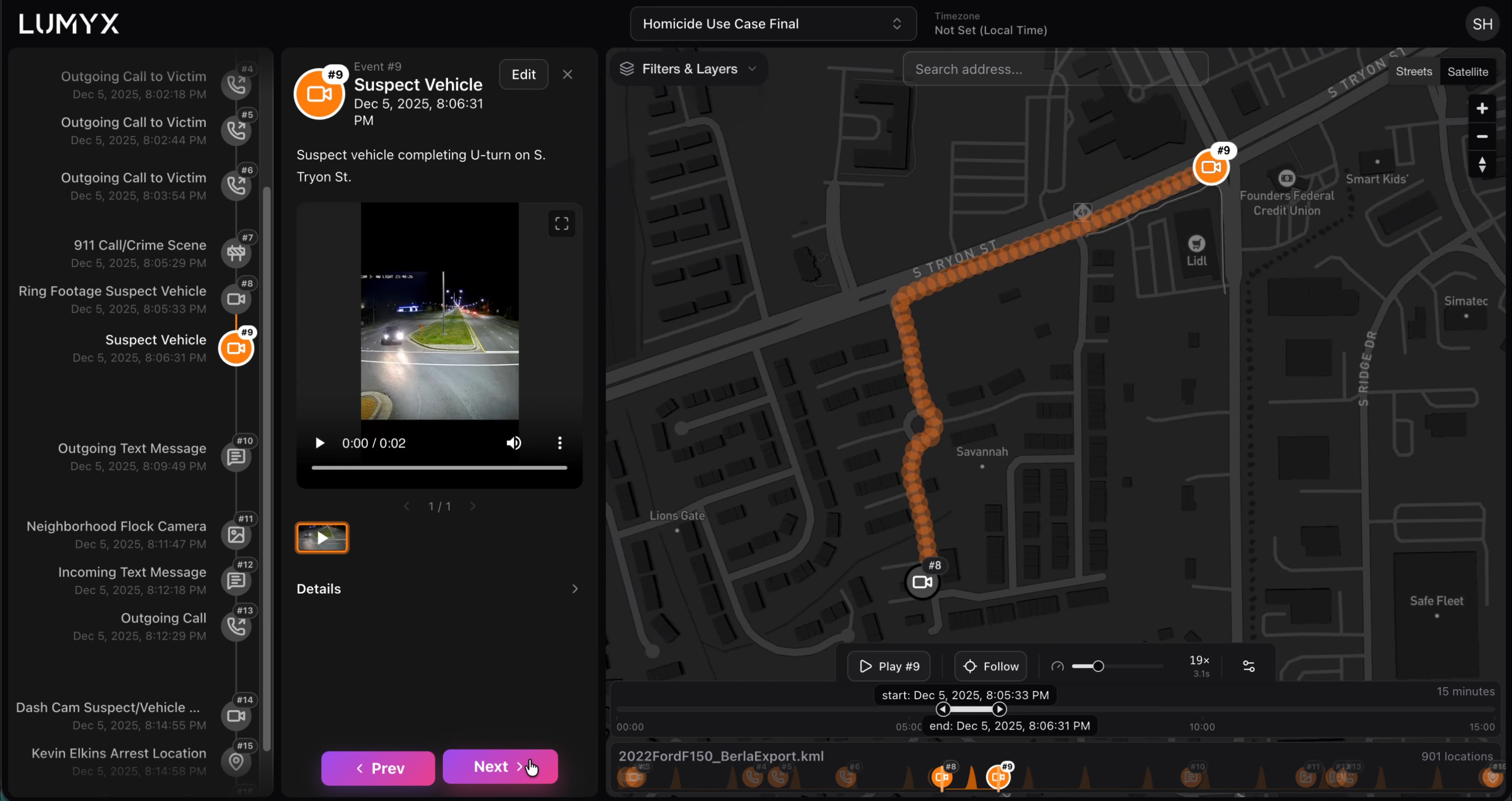
Every investigative tool is good at holding evidence. None of them is good at telling the story.
Ask where a case lives and you get a list of tools: the phone extraction in one, the call detail records in another, plate reader hits in a third, video in a folder, reports in the records system. Each one is deep, specialized, and readable mostly by the person who works in it. The case itself — the actual account of what happened — exists in no single place.
So every time the case has to travel — a briefing, a charging decision, a courtroom — someone condenses it into a summary. The format varies; the result doesn't. Somewhere between the evidence and the audience, the case loses its force.
Why summaries fail the case
Condensing a case has three failure modes, and everyone who has briefed a command staff or presented to a jury has felt all of them.
It isn't compelling. A case is a story that unfolds — a phone moving toward a scene, a vehicle appearing where it shouldn't be, a window of minutes where everything converges. A summary doesn't unfold; it states. The people making decisions are asked to feel the weight of a sequence of events from frozen exhibits, and frozen exhibits don't carry weight.
It's too detailed — or not detailed enough. The underlying evidence is overwhelming: hundreds of thousands of records, weeks of activity, hours of footage. Any summary has to choose between drowning its audience in detail and cutting so much that the story loses its support. Both choices produce the same reaction on the other side of the table: confusion, or doubt.
It's static. Time is the substance of a case — what moved, when, in what order, how fast. A static format can describe motion, but it can't show it. The dimension that matters most is exactly the one a fixed page or slide can't hold.
The timeline is the one thing everyone can read
Here's what makes this solvable: every one of those audiences already thinks in the same format. This happened, then this, here, then here. The detective reasons in it, the sergeant wants the briefing in it, the prosecutor structures the argument in it, and the jury follows it without any training at all.
That's the case for the digital evidence timeline as the center of casework — not another report generated at the end, but the place where the scattered case becomes one account. The instinct to build timelines is already universal. What's changing is the medium: from summaries that freeze the case to software that lets it move.
What investigation timeline software actually does
Crime timeline software is not a charting exercise. The job is specific:
- Ingest every source in its native format — extractions, CDRs, ALPR hits, GPS and KML files, video, subpoena returns — without retyping any of it.
- Put every event on one clock, with time zone handling that survives cross-examination.
- Keep time and place together, so the case plays out on a map instead of scrolling past as a list.
- Play back. Scrubbing through a case surfaces patterns no static format can show, and it's how everyone else finally sees what the investigator already knows.
- Stay traceable. Every event stays linked to the record it came from, so the timeline you prepared with is the one you can defend in court.
One artifact, from first briefing to closing argument
Here's what changes when the timeline is live instead of frozen.
Monday morning, the detective scrubs through the weekend's imports and sees the new plate hits sitting next to the tower activity — a gap in the story just closed. Tuesday's briefing is the same screen, not a summary assembled the night before; when the sergeant asks about the hour before the shooting, the answer is a drag of the slider. Months later, the prosecutor builds the case timeline for trial in the same view, and every map and event that might be challenged has its source record one click beneath it. In court, the jury doesn't get read a chronology — they watch it happen, in time, on a map.
One version of the case, richer every week, never rebuilt. Staleness and competing versions stop being problems because there are no copies to go stale.
We call it the crimeline
Lumyx was built around this idea. The crimeline is the case timeline where everything lives together — the extraction, the tower records, the plate hits, the clips, and the events the investigator adds along the way — on one clock and one map, explored by moving through time, and presented in court exactly as it was built.
Load one real case into it and the old summaries become hard to go back to. Not because anyone did them wrong, but because a case that can tell its own story no longer needs to be condensed into something less than it is.